
01 Faith · evidence · the human question
Humanity Through Grace†
A calm investigation of ancient Christian ideas, modern research and the questions neither can settle alone.
Begin the inquiry

Some questions are too human to belong to one discipline.
What do we do with hurt? Why do we need each other? What makes a life meaningful? What is worth hoping for when life becomes difficult?
A teenager, a therapist, a priest and a philosopher can all ask those questions. They will not mean exactly the same thing — and that is why the conversation matters.
Christianity offers claims about grace, love, suffering, forgiveness, community and hope. Psychology can study parts of the lived experience. Philosophy can test the ideas. History can show us where they came from. None of them needs to swallow the others.
FAITH / PSYCHOLOGY / FLOURISHING
The measurable human experience
meets an immeasurable claim.
A recent paper in Pastoral Psychology brings Karl Rahner's theology of grace into dialogue with positive psychology. Its value is not that it “proves” faith. It shows that theology and psychology can ask overlapping questions about meaning, relationship, transcendence and flourishing while remaining different kinds of enquiry.
Rahner is one influential Catholic voice, not a summary of every Christian tradition. The point here is the conversation between disciplines, not to flatten their differences.
Read the paper ↗Evidence gets a label.
Claims get a boundary.
The aim is simple enough for anyone to follow and rigorous enough to survive a serious question.
Randomised trial
Useful for testing whether an intervention causes a change.
Meta-analysis
Combines results across many studies. Quality still depends on the studies inside it.
Longitudinal
Tracks people through time. Stronger than a snapshot, but confounding can remain.
Observational
Shows patterns and associations. It cannot by itself prove cause.
Theological claim
A claim of faith or interpretation — never disguised as a lab result.
Plain words before jargon. If an idea cannot be explained clearly, we have not understood it well enough.
Small effects stay small. Interesting evidence does not need exaggeration.
Uncertainty stays visible. A null result, a caveat or a contradiction belongs on the page.
What does it cost
to let go?
Forgiveness is often confused with saying the harm was fine. It is not. Forgiveness can exist without forgetting, excusing, restoring trust or returning to an unsafe relationship.
Psychology can ask a narrower question: after real interpersonal hurt, what happens when people work through a structured process of forgiveness?
What if forgiveness does not erase the debt — but stops the debt from owning the person who was hurt?
Read the nuance +
A systematic review and meta-analysis of randomised trials found reductions in depression, anger/hostility and stress/distress after process-based forgiveness interventions. The authors described the evidence as moderately strong and called for more research.
That evidence concerns therapeutic processes. It does not tell anyone when reconciliation is wise, whether trust should be restored, or how justice should work.
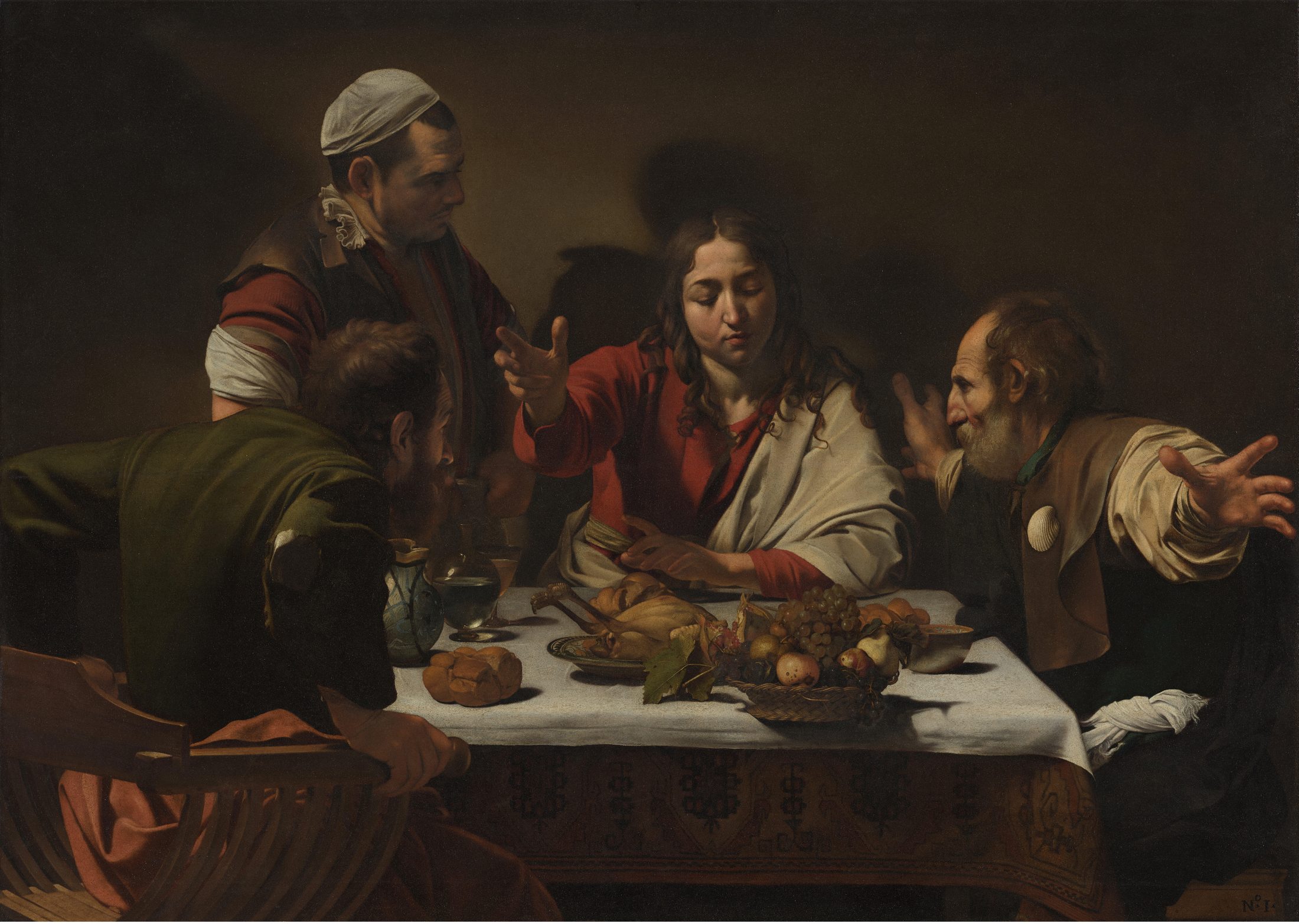
Caravaggio, Supper at Emmaus · National Gallery, London · public-domain reproduction
Receiving before
possessing.
Gratitude is not pretending everything is good. A mature version is quieter: noticing that even a difficult life may still contain something received rather than earned.
A small positive overall effect on wellbeing compared with control conditions.
The pooled effect was small and varied between countries. In the United Kingdom, the country-specific estimate was not statistically significant. Gratitude may help, but it is not a universal happiness switch.
Choi et al., PNAS 2025 ↗Gratitude is not denial. It is attention.
One layer deeper +
The headline number is an average, not a promise to an individual. The meta-analysis found substantial variation across studies and countries, and its prediction interval included zero — meaning a future study could reasonably find little or no benefit.
That is not a reason to dismiss gratitude. It is a reason to describe it accurately: potentially useful, usually modest, and shaped by context.
We were never
meant to flourish alone.
Longitudinal research across young, middle-aged and older adults has linked regular religious-service attendance with several later outcomes, including purpose, social integration, life satisfaction and some measures of mental and physical health.
But “going to church” is not one ingredient. It bundles repeated gathering, friendship, ritual, shared stories, practical help, service, identity and meaning. That makes religious community both powerful to study and difficult to reduce to a single cause.
Community is not automatically good. It can also become coercive, excluding or unsafe. The serious question is not “is religion healthy?” but what kinds of community help people flourish, for whom, and why?
One layer deeper +
These studies follow people over time, which is more informative than a one-off survey. They still cannot randomly assign a life of worship, friendship and belonging. People who attend services may differ in other ways that matter.
So the careful conclusion is association over time — not “church attendance has been proven to cause health.” The bundle itself is part of the mystery: ritual, relationships, identity, service and meaning arrive together.
Faith can carry
pain, too.
A serious account of religion has to make room for doubt, guilt, exclusion, anger at God, fear, moral conflict and the feeling that the sacred has gone silent.
In a longitudinal study of Colombian university students, religious or spiritual struggle and poorer functioning appeared to influence each other over time. Struggle predicted later declines across most measured areas of functioning, and worse functioning also predicted more later struggle.
That does not make doubt a failure of faith. It makes struggle part of the human story.
The Bible does not remove protest from prayer. It preserves it.
Prayer is not a
wellbeing hack.
That may be exactly why a null result is worth showing.
NO EXTRA
FLOURISHING
EFFECT DETECTED.
In a 28-day randomised trial with self-identifying Christians, religiously framed Centering Prayer did not outperform the comparison conditions on the primary flourishing outcome.
It did produce differences on acute measures of spiritual experience. That distinction is useful: a practice may carry spiritual meaning without producing an extra measurable wellbeing advantage.
And a wellbeing trial cannot tell us whether a prayer was heard.
One layer deeper +
The primary outcome matters because it was the main test the trial set out to examine. Secondary findings can still be interesting, but they should not be used to quietly replace a primary result that was null.
This is a useful boundary between spiritual meaning and psychological measurement: the study can compare reported experiences; it cannot adjudicate the object, truth or recipient of prayer.
What happens when
the self is no longer
the biggest thing?
Awe is the feeling of meeting something so vast — nature, music, birth, beauty, the night sky, the sacred — that our normal mental frame has to stretch.
This was a small first randomised clinical trial in a specific group: adults living with long COVID. It is early evidence, not a general law — and certainly not evidence that the object of awe is divine.
One layer deeper +
Awe is sometimes described as a “small-self” experience: attention expands beyond ordinary self-concern. That description is psychological. It does not settle whether transcendence is only a state of mind or a response to something real beyond the self.
That gap between experience and interpretation is exactly the kind of border this project is interested in.
Awe can be measured. What is worthy of awe is a different question.
Love is not only
a feeling.
Christian ethics turns love outward: toward the neighbour, the stranger and the person who suffers.
A 2020 meta-analysis covering 201 studies and 198,213 participants found a modest positive relationship between prosocial behaviour and wellbeing. The link was stronger for eudaimonic wellbeing — meaning and functioning — than for simple pleasure.
If kindness only mattered when it made the giver feel good, would it still be kindness?
The evidence does not say helping always feels good, or that self-sacrifice without boundaries is healthy. It says the relationship between doing good and living well is real, modest and complicated.
One layer deeper +
A separate 2025 meta-analysis of compassion for others reported an overall positive association with wellbeing across 54 effect sizes. But the authors were cautious about causality because consistent controlled intervention comparisons were limited.
That distinction matters. Compassion may accompany a good life without being a technique for manufacturing one. Christianity makes the stronger moral claim that the neighbour matters even when love is costly.
Why get up
tomorrow?
Purpose is the sense that your life has direction — that there is something worth moving toward.
A 2026 meta-analysis found that higher purpose in life was consistently associated with lower risk of earlier mortality across large longitudinal datasets. The association became smaller after adjusting for behavioural, clinical and psychological factors, but it remained.
The authors also reported substantial heterogeneity and signs of publication bias. Purpose is associated with health; that does not mean purpose has been proven to cause longevity.
Research can ask whether purpose predicts health.
It cannot tell us which purpose is true, good or worth giving a life to.
One layer deeper +
Across 25 samples, higher purpose was associated with lower mortality risk. The association weakened after adjustment for health, behaviour and depression but remained present. The analysis also found substantial heterogeneity and signs of publication bias.
So purpose is not a longevity prescription. More importantly, a harmful purpose can be deeply motivating. Evidence about outcomes cannot replace the ethical question: purpose toward what?

The themes are not
separate rooms.
Put them beside one another and a pattern begins to appear. Not a proven causal pathway. Not a scientific model. A family resemblance.
Worth begins as gift, not a score to be earned.
Gift becomes something we learn to notice.
What is received is lived with other people, not alone.
Relationship asks what we do when people wound one another.
Faith refuses to edit pain, doubt and protest out of the story.
Attention turns beyond the self and asks what deserves our deepest regard.
Attention turns outward again: toward a neighbour, a task, a life worth giving.
Christianity does not present these as seven wellbeing tricks. It places them inside a larger story: gift can become attention, belonging, mercy, endurance and love.
Research can examine pieces of that movement. Philosophy can ask whether the story is coherent. Faith makes the further claim that grace has a source.
CORRELATION
IS NOT
REVELATION.
Measurement is powerful partly because it is limited. It forces a precise question. It also leaves some questions untouched.
Can measure reported wellbeing, behaviour, cognition and emotion.
Can measure symptoms, health outcomes, physiology and risk.
Can test concepts, reasons, assumptions and arguments about what is true or good.
Asks what grace, God, salvation, love and human purpose ultimately mean within a tradition of faith.
None can simply replace the others. The interesting territory is the border.
Gift before
achievement.
At its simplest, Christian grace is an unearned gift. It cuts against the idea that human worth is a scoreboard built from success, status, goodness or productivity.
Most of this page has asked what forgiveness, gratitude, community, prayer, awe, compassion and purpose might do for us. Grace turns the question around.
What if the deepest good is not something we produce?
That does not make effort meaningless. In Christian thought, grace changes what effort is for: not a way to purchase worth, but a response to something already given.
What do we mean by grace? +
Christian traditions do not explain grace in exactly the same way. Catholic, Orthodox and Protestant traditions differ over questions such as human freedom, works, sacraments and salvation.
This site uses the word in a broad shared sense: God's gift is prior to human achievement. The disagreements matter — but they begin inside a common language of gift.
Science can study human responses to practices and beliefs.
It cannot run an experiment on grace itself.
HUMANITY THROUGH GRACE
You do not have to leave convinced.
Only more awake to the question.
Read the papers. Follow the links. Notice the caveats. Disagree carefully. The point is not to make faith smaller by measuring it — or science weaker by asking it to become theology.
Return to the beginning ↑